
Scott County Court Records After Arrest
Court records after a jail arrest in Scott County follow a clear path. Arrest and booking are law-enforcement events. The Scott County Attorney's Office prosecutes felonies, gross misdemeanors, and misdemeanors that occur in the county. Once the prosecutor files charges, the case is handled in Scott County District Court, which has original jurisdiction over criminal and traffic cases filed in Scott County. The public online search channel is Minnesota Court Records Online, usually called MCRO.
The booking side and the court side should stay separate. Use Scott County jail inmate records to confirm current jail custody or booking-related jail records. Use Scott County jail mugshots for booking-photo access rules. Use MCRO and District Court for the charge record, hearing record, warrant entries, bond changes, dispositions, and public documents available for remote access.
Search Court Records After Arrest
The best search key is the case number because MCRO warns that pending criminal, traffic, and petty misdemeanor cases with no conviction will not return by defendant-name search. A case number may appear in jail paperwork, bail paperwork, a citation, a court notice, or a calendar entry. When no case number is available, search by name, use Criminal as the case category, and set the court location to Scott County.
MCRO information is unofficial. Certified copies come from court administration, and some public courthouse records are not available through remote access. Name searches also carry identity risk because people can share names, birthdates, aliases, or spelling variations. For a pending charge after a jail arrest, the case number and Scott County court location filter are often the cleanest way to avoid a false match.
- Confirm the arrest or custody event through jail records, jail phone, or paperwork.
- Open MCRO Case Search and accept the required terms.
- Search by case number first when one is available.
- If searching by name, use the person's legal name and filter to Criminal cases in Scott County.
- If no pending case appears by name, contact Scott County District Court or use courthouse terminals.
- Use BCA CHS only for public conviction-history data, not for arrest-only data.
The MCRO case search portal is the statewide court-record entry point for filed Scott County criminal cases.
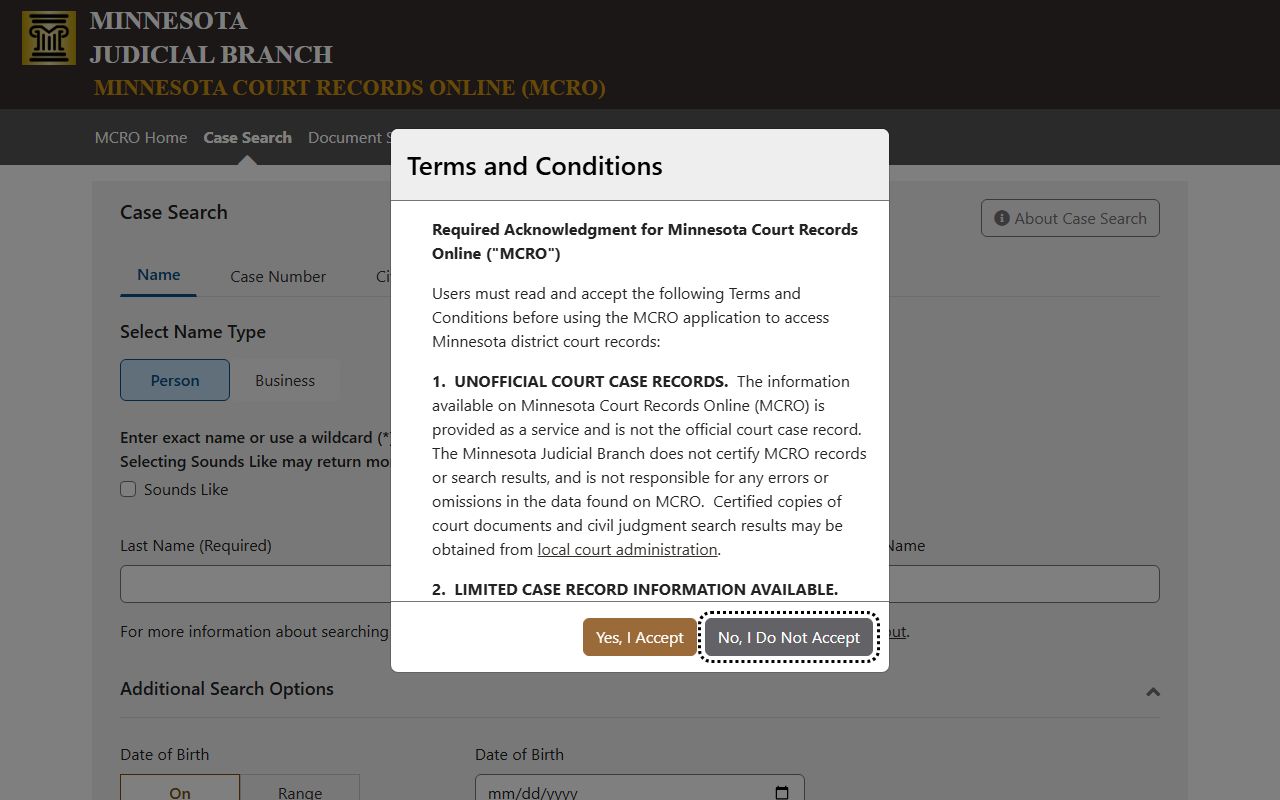
The MCRO image matches the search-field rules that matter most after an arrest: case number search is stronger than name search for pending criminal matters.
Scott County MCRO Search Fields
MCRO offers several search routes. Name searches can be broad or narrow, but they are limited by remote-access rules and pending-case restrictions. Case number searches are often more reliable for court records after a jail arrest. Citation searches may help for traffic or citation-based matters, and attorney search is useful when counsel is known.
| Field Label | Type | Required | Options / Notes |
|---|---|---|---|
| Search type | Tab | Yes | Name, Case Number, Citation Number, Attorney. |
| Select Name Type | Radio | For name search | Person or Business. |
| Last Name | Text | For person search | Exact name or trailing wildcard after two characters. |
| First Name | Text | Optional | Sounds Like can broaden search; wildcards cannot be used with Sounds Like. |
| Date of Birth | Date or range | Optional | Helps separate people with the same name. |
| Date Filed | Date or range | Optional | Useful when the arrest date is known. |
| Case Category | Filter | Optional | Choose Criminal for filed criminal cases. |
| Court Locations | Picker | Optional | Select Scott County from the county list. |
Charging Documents After Arrest
The court record begins with a charging document. In Scott County, the County Attorney prosecutes felonies, gross misdemeanors, and misdemeanors. The arrest may explain why a person was booked, but the charging document explains what the prosecutor has filed in court. The filed charge can differ from the booking reason because prosecutors review reports, evidence, witness statements, criminal history, and legal elements before filing.
| Document | Who Usually Files It | How It Functions |
|---|---|---|
| Complaint | Prosecutor, often based on law-enforcement reports | Common Minnesota charging document that starts many criminal cases after arrest. |
| Information | Prosecutor | Formal charge document used in some felony or higher-level proceedings. |
| Indictment | Grand jury | Used for serious matters when a grand jury returns charges. |
Scott County Charge Status
Charge status changes as the case moves. A first appearance may address bail and conditions. Later hearings may address probable cause, plea talks, amendments, dismissal, trial, or sentencing. Jail roster language may lag or differ from the final court charge. The court record is the better source for the current filed charge status once the case exists.
| Status | What It Means |
|---|---|
| Pending | The charge is filed and the case has not reached final disposition. |
| Amended | The prosecutor or court changed the filed charge, level, or wording. |
| Reduced | The charge level or count became less severe, often through agreement or court action. |
| Dismissed | The charge was ended without a conviction on that count. |
| Convicted | A plea or verdict produced a conviction on that charge. |
| Warrant issued | The court issued a warrant, often after failure to appear or a new court order. |
Bond in Court Records
Bond connects jail custody to the court record. Scott County accepts bail at the jail lobby or online through Access Corrections when bail is set. Cash and credit card payments are accepted according to the county page, and Minnesota-approved licensed bail bondsmen can post bonds in the jail lobby. The court may change bail after a first appearance, bail hearing, omnibus hearing, plea, sentencing, or new warrant event.
| Release Term | How It Works |
|---|---|
| Cash bond | Money paid directly through the jail lobby or available online route. |
| Credit-card bail | County accepts credit cards; vendor fees may apply online. |
| Surety bond | A Minnesota-approved licensed bail bondsman posts through the jail lobby process. |
| No-bond hold | Release is blocked because no bail is set or another hold prevents release. |
| Detainer or hold | Another warrant, DOC/parole hold, federal hold, immigration detainer, or court order may keep the person in custody. |
Warrants and Court Arrest Records
Scott County did not have a captured official active-warrant search in the research. The Jail / Warrants page says the Jail Division includes the Sheriff's Office Warrants Unit, and warrant information for Scott County should be checked by calling 952-496-8314. Other Minnesota warrants must be obtained from the issuing jurisdiction. MCRO may show warrant-related case entries, hearing failures, first appearances, bail hearings, or dispositions when the warrant is tied to a filed court case.
A warrant arrest can start as a jail custody event, then become a court record when the defendant appears or a case entry is updated. A bench warrant often follows failure to appear. An arrest warrant directs law enforcement to arrest a person. A search warrant is different because it authorizes a search or seizure and does not always mean the person was booked.
Charges Versus Convictions
A Scott County court record after a jail arrest can contain charges that never become convictions. A charge is an accusation filed by the prosecutor. A conviction follows a guilty plea, verdict, or other conviction disposition. Public conviction history is searched through BCA CHS, which excludes arrest data, juvenile data, federal data, and other noncovered material.
| Point | Charge | Conviction |
|---|---|---|
| Stage | Filed accusation after arrest or citation | Final finding after plea, verdict, or qualifying disposition |
| Meaning | Case is alleged and must still be proved or resolved | Person has been found or has admitted guilt for that count |
| Search source | MCRO case record, subject to limits | MCRO and BCA public conviction history when eligible |
| Common mistake | Treating a filed charge as proof | Assuming all original charges were sustained |
Sealed and Expunged Records
Minnesota expungement is governed by Chapter 609A. The research notes both petition and automatic sealing frameworks. Expungement can seal eligible records from public view, but it does not necessarily erase every copy that was lawfully distributed before sealing. MCRO remote-access limits can also mean some public courthouse records are not available online.
| Issue | Sealed | Expunged |
|---|---|---|
| Public visibility | Hidden from ordinary public access | Sealed from public view under the expungement order or automatic rule |
| Authority | Court rule, statute, or case classification | Minn. Stat. ch. 609A |
| Effect on older copies | May not reach copies already distributed | Does not guarantee removal from every outside copy |
| How to check | Court administration or courthouse terminal | Court order, Clean Slate notice, or legal review |
Scott County Court Offices
Scott County District Court is located at the Scott County Courthouse / Justice Center, 200 Fourth Avenue W., Shakopee, MN 55379, with phone 952-496-8200. The court administrator named in the research is Jennifer Everett. Certified copies and courthouse access questions should go through court administration, not the jail roster. The Scott County Attorney's Office is at GW-300 Government Center West, 200 Fourth Avenue West, Shakopee, MN 55379, phone 952-496-8240, and is the prosecution office for county criminal cases.
For public conviction history, use the Minnesota BCA Public Criminal History Search rather than MCRO as a background-check substitute. BCA CHS publishes public conviction data under Minnesota law and excludes arrest data, juvenile data, federal records, and other-state data. That makes it narrower than the court case file in some ways and more purpose-built for conviction-history checks in others.
The Scott County District Court page lists local court contact information and jurisdiction.
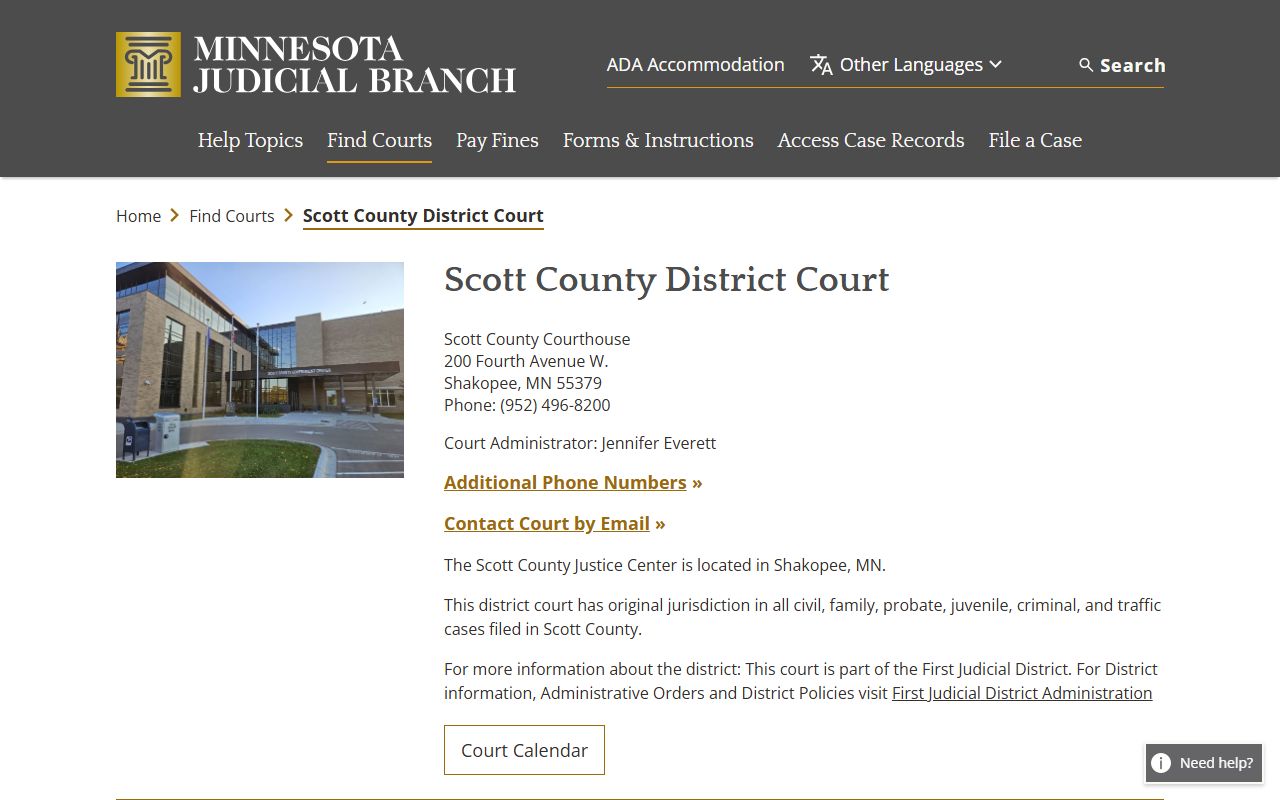
The District Court image helps separate court case access from jail custody access, which is the key distinction after an arrest.